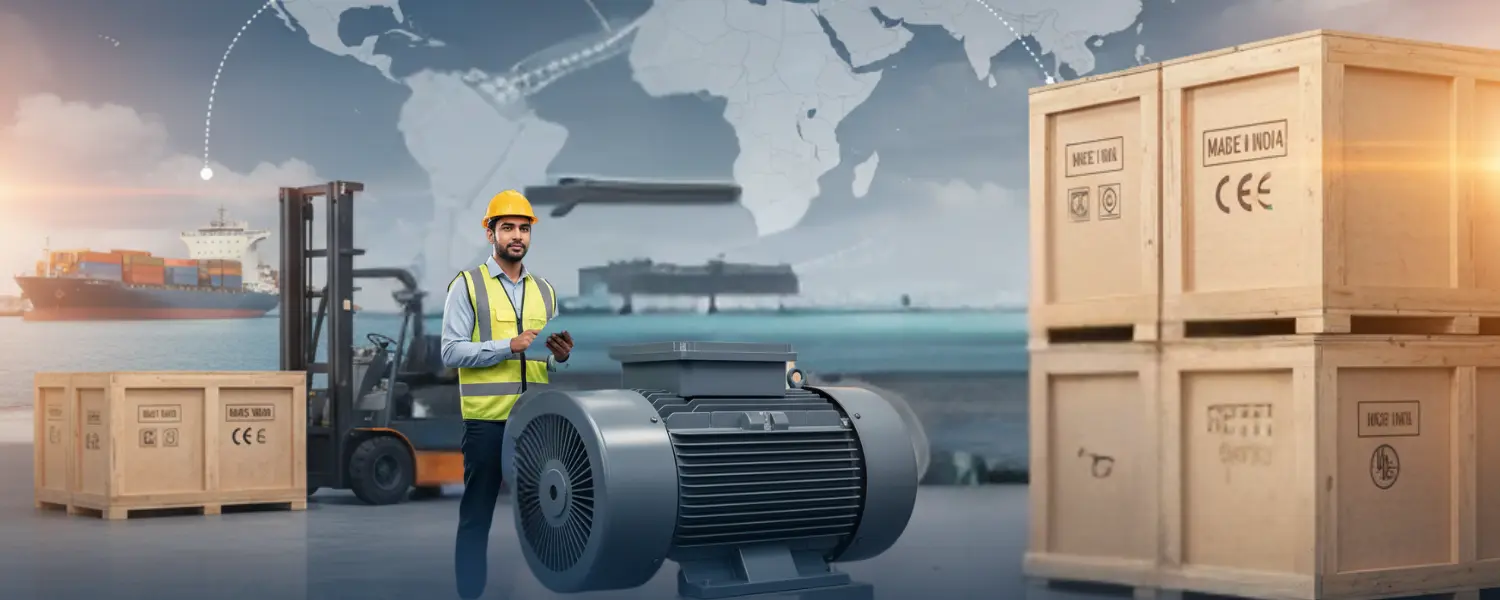
In today’s industrial landscape, energy efficiency is no longer a buzzword; it’s a critical financial and environmental strategy. At the heart of this strategy lies the electric motor, the unsung workhorse that powers everything from factory conveyor belts and HVAC systems to pumps and compressors. As businesses look to optimize operations and reduce costs, the demand to export Energy Efficient Motors has skyrocketed.
However, sourcing industrial motors internationally is a far more complex task than simply finding the right horsepower and price. Every country and region operates under its own set of technical standards, energy regulations, and compliance codes. Sourcing a non-compliant motor is a high-stakes gamble that can result in catastrophic project failures, legal penalties, and significant financial losses.
This guide will walk you through the complex landscape of global standards to help you source compliant, high-performance motors for export for your next international project.
Why Compliance is Non-Negotiable for Motors for Export
Before diving into the standards, it’s crucial to understand the risks of getting it wrong. A non-compliant motor isn’t just a technical problem; it’s a major business liability.
Project Delays and Rejection: A shipment of motors for export that doesn’t meet the destination’s standards can be seized by customs, halting your project for weeks or months while you scramble to source compliant replacements.
Operational Failure: The most immediate technical problem is a mismatch in voltage and frequency. A motor designed for India’s 50Hz grid will run 20% faster and burn out quickly on a 60Hz grid like in the US. This leads to premature failure and equipment damage.
Financial Penalties and Legal Action: If a non-compliant motor is installed, local inspectors can impose substantial fines and force a complete, costly removal and replacement.
Safety and Insurance Risks: Electrical standards are primarily about safety. A non-compliant motor can pose a serious fire hazard and, in the event of an accident, will almost certainly void your facility’s insurance coverage.
Decoding the "Alphabet Soup" of Global Motor Standards
Navigating the world of motor compliance means understanding a few key acronyms. A true export Energy Efficient Motors partner must be an expert in these.
1. The IE Efficiency Classes (The “E” in Energy Efficient) This is the most important standard for efficiency. The International Electrotechnical Commission (IEC) defines several “IE” classes to classify motor efficiency.
IE1: Standard Efficiency (Largely phased out in many countries).
IE2: High Efficiency.
IE3: Premium Efficiency (This is the minimum legal requirement for new motors in the EU, US, India, and many other regions).
IE4: Super Premium Efficiency.
IE5: Ultra Premium Efficiency.
Sourcing an IE2 motor for a project in Europe or the US would be a major compliance failure. A key part of sourcing motors for export is ensuring they meet the minimum legal IE class of the destination country.
2. IEC (International Electrotechnical Commission) The IEC provides the foundational global standards for all rotating electrical machines (IEC 60034 series). This standard dictates everything from a motor’s performance characteristics and testing methods to its physical dimensions and mounting, ensuring a level of interchangeability and quality.
3. NEMA (National Electrical Manufacturers Association) While most of the world uses IEC standards, North America (primarily the US, Canada, and Mexico) uses NEMA standards. NEMA has its own efficiency classifications, such as “NEMA Premium,” which is largely equivalent to IE3. An expert partner must know whether to engineer and source an IEC-compliant or a NEMA-compliant motor for your project.
4. Regional Safety Certifications (UL, CE)
UL (Underwriters Laboratories): This is a critical safety certification for any electrical component being sent to the United States. A “UL Listed” mark means the motor has been independently tested for safety.
CE Mark (Conformité Européenne): This is a mandatory mark for products sold within the European Economic Area. It signifies that the motor meets the EU’s high safety, health, and environmental protection requirements.
Why Source Compliant Motors from India?
India has emerged as a global powerhouse for high-quality engineering and manufacturing. This is driven by:
Engineering Expertise: India has a massive pool of skilled engineers capable of designing and manufacturing motors that meet a wide variety of complex international standards.
Cost-Effectiveness: Due to large-scale production and a competitive ecosystem, Indian manufacturers can produce high-efficiency (IE3/IE4) motors at a highly competitive price point.
Government Support: Initiatives like “Make in India” have bolstered the manufacturing sector, ensuring a focus on quality and export readiness.
This combination makes India a strategic, cost-effective, and reliable hub for sourcing your next export Energy Efficient Motors project.
The Role of Your Export Partner in Guaranteeing Compliance
The responsibility for navigating this complex web of standards should not fall on you. This is the primary value of a true global export partner. They are not just a supplier; they are your compliance and logistics experts.
Here’s what you should expect from your partner:
Custom Engineering for Compliance: They won’t just sell you an off-the-shelf motor. They will ask for the destination country and custom-engineer a solution that meets the specific voltage, frequency, IE efficiency class, and safety certifications (UL/CE) required.
Complete Documentation Management: A professional partner will manage and provide a complete documentation package for a smooth customs clearance. This includes certificates of origin, factory test reports, and all necessary compliance certificates.
Secure Global Logistics: They must be experts in packaging these high-value motors for export, ensuring they are protected from moisture and shock during international freight.
By prioritizing compliance from day one, you can ensure your export Energy Efficient Motors are not just a purchase, but a safe, legal, and highly cost-effective long-term investment.
Frequently Asked Questions (FAQ's)
What is the difference between an IE3 and an IE4 motor?
IE3 (Premium Efficiency) and IE4 (Super Premium Efficiency) are international efficiency classes. An IE4 motor has significantly lower energy losses than an IE3 motor, leading to greater long-term cost savings. Many countries now mandate IE3 as the minimum standard.
What’s the difference between IEC and NEMA motor standards?
IEC is the global standard used by most of the world. NEMA is the standard used primarily in North America. They have different classifications for efficiency, dimensions, and enclosures. A true export partner must know which standard your project requires.
Can I use a 50Hz motor in a 60Hz country (like the US)?
No. Running a 50Hz motor on a 60Hz supply will cause it to run 20% faster, draw more current, and overheat, leading to a quick and catastrophic failure. The motor must be engineered for the destination’s specific frequency.
Why is compliance so important when I export Energy Efficient Motors?
Compliance is a legal and safety requirement. Non-compliant motors for export can be seized by customs, incur large fines, void your insurance, and pose a serious fire and safety risk to your facility.
What kind of documentation is needed for a motor export?
You will need a full documentation package, including a commercial invoice, packing list, bill of lading, certificate of origin, and—most importantly—all compliance certificates (e.g., CE) and factory test reports proving the motor meets the required standards.
Why is India a good country to source energy-efficient motors from?
India has a strong and competitive manufacturing base with a large pool of skilled engineers. This allows them to produce high-efficiency (IE3/IE4) motors that meet strict international standards at a very cost-effective price point.
What is a “UL Listed” mark, and why does it matter?
The UL mark is a safety certification from Underwriters Laboratories, primarily for the US market. It means the motor has been independently tested and certified to meet the highest safety standards, which is often a legal or insurance requirement.
What is the role of an export partner in sourcing motors?
A true export partner acts as your single point of contact to manage the entire process. They provide the custom engineering for compliance, source the high-quality motor, handle all the complex export paperwork, and manage the global logistics to deliver a fully compliant, ready-to-install solution to your site.