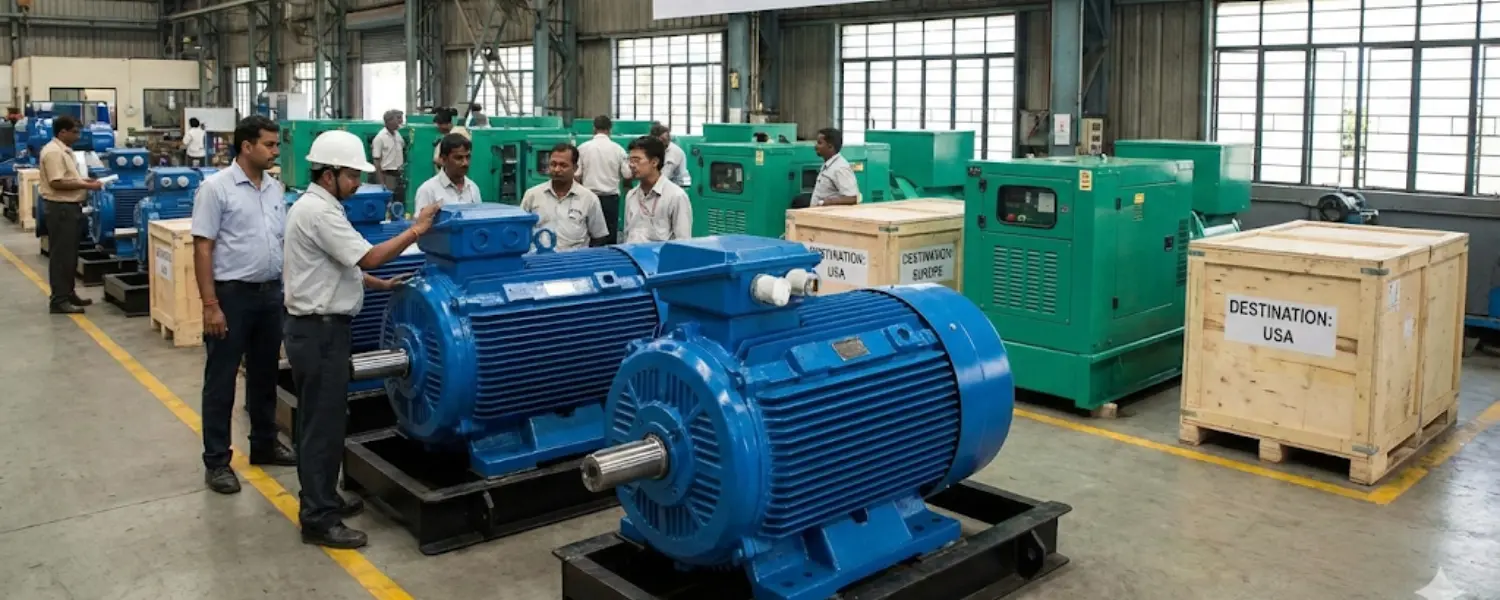
In the competitive global market for industrial machinery, procurement managers and project leads are under constant pressure to balance three critical factors: cost, quality, and compliance. For decades, the sourcing conversation was dominated by established Western manufacturers or mass-production hubs in East Asia. However, a significant shift is underway. India has emerged as a premier destination for sourcing Energy-Efficient Motors & Generators, offering a unique strategic advantage that goes beyond simple price arbitrage.
Driven by stringent government mandates, a deep engineering talent pool, and a commitment to international standards like IE3 and IE4, India is no longer just a “low-cost” option. It is a high-value partner for global industries looking to optimize their Total Cost of Ownership (TCO) while meeting rigorous sustainability goals. Here is why sourcing from India is the smart strategic move for your next project.
1. Engineering Excellence: The "Over-Engineered" Advantage
Unlike markets focused solely on volume, the Indian manufacturing ethos is deeply rooted in durability and precision engineering. Indian manufacturers have a long history of producing heavy-duty electrical equipment designed to withstand harsh operating conditions—fluctuating voltages, high ambient temperatures, and dust.
When you source Energy-Efficient Motors & Generators from India, you are often getting equipment that is “over-engineered” compared to standard commercial-grade units. This translates to:
Robust Insulation Systems: Designed to handle voltage spikes and resist thermal degradation, extending the motor’s lifespan.
Higher Service Factors: Generators built to handle temporary overloads without tripping, ensuring reliability during critical startup phases.
Customization Capabilities: Indian manufacturers are renowned for their flexibility. Whether you need a non-standard frame size, a specific IP rating for a dusty mine, or a custom winding for a unique voltage, Indian exporters can adapt designs faster and more affordably than their rigid mass-production counterparts.
2. Cost-Competitiveness Without Compromising Quality
The financial argument for sourcing from India is compelling. While Western manufacturers grapple with high labor and operational costs, India offers a competitive edge that directly impacts your bottom line. However, this isn’t about cutting corners; it’s about structural efficiency.
Economies of Scale & Skilled Labor: India boasts one of the world’s largest pools of skilled electrical engineers and technicians. This allows for sophisticated manufacturing processes at a lower operational cost.
Domestic Raw Material Availability: With a robust domestic supply chain for critical materials like steel, copper, and aluminum, Indian manufacturers are less vulnerable to global commodity price shocks, allowing them to offer stable and competitive pricing.
Value for Money: You get IE3 (Premium Efficiency) and IE4 (Super Premium Efficiency) motors at a price point that often rivals standard efficiency models from other regions, significantly improving your project’s ROI.
3. Alignment with Global Efficiency Standards (IE3 & IE4)
Global regulations are tightening. The European Union, USA, and other major markets are mandating higher efficiency standards to combat climate change. India is in lockstep with this global trend. The Bureau of Indian Standards (BIS) has harmonized its regulations with global IEC standards, mandating IE2 and IE3 efficiency levels for domestic use and promoting IE4 for export.
This means that Energy-Efficient Motors & Generators sourced from reputable Indian exporters are not just “compliant enough”; they are built to meet the world’s strictest energy norms.
Future-Proofing: By sourcing IE3 or IE4 motors from India today, you ensure your machinery meets current and future regulatory requirements in markets like the EU and North America.
Seamless Integration: Indian motors are designed with standard IEC frame sizes, ensuring they can easily replace existing units in your facility without requiring expensive modifications to mountings or couplings.
4. Supply Chain Resilience and Diversification
The post-pandemic world has taught us the danger of relying on a single source or region for critical components. “China Plus One” is no longer just a buzzword; it is a necessary survival strategy. Sourcing from India provides a critical diversification option, de-risking your supply chain.
India’s strategic location, with major ports connecting to the Middle East, Africa, Europe, and Southeast Asia, ensures reasonable shipping times. Furthermore, the Indian government’s “Make in India” initiative has heavily invested in logistics infrastructure, streamlining the export process and reducing lead times.
5. A Focus on Sustainable and Green Manufacturing
Sustainability is becoming a key metric for global procurement. Indian manufacturers are increasingly adopting green manufacturing practices, driven by both government policy and global demand. Sourcing Energy-Efficient Motors & Generators from India aligns with your company’s ESG (Environmental, Social, and Governance) goals.
Reduced Carbon Footprint: High-efficiency motors consume less electricity, directly reducing your Scope 2 greenhouse gas emissions.
Sustainable Production: Many top Indian exporters are investing in renewable energy for their own factories, further lowering the “embodied carbon” of the products you buy.
In conclusion, sourcing from India offers a powerful convergence of benefits: world-class engineering, global compliance, cost efficiency, and supply chain security. It is a strategic advantage that positions your business for long-term reliability and success in a demanding global market.
Frequently Asked Questions (FAQ's)
Are Indian electric motors compliant with international standards like IEC and NEMA?
Yes. Reputable Indian manufacturers produce motors that strictly adhere to IEC (International Electrotechnical Commission) standards, specifically IEC 60034-30-1 for efficiency classes (IE2, IE3, IE4). Many also offer NEMA-compliant frames for the North American market.
What is the difference between IE3 and IE4 motors sourced from India?
IE3 refers to “Premium Efficiency,” while IE4 is “Super Premium Efficiency.” IE4 motors have lower energy losses (often 15-20% less than IE3) and higher reliability. While IE4 motors cost slightly more upfront, they offer significantly higher long-term savings on electricity bills.
Why are Indian motors considered “cost-effective” if they are high quality?
The cost advantage comes from India’s lower labor and operational costs, combined with a strong domestic supply of raw materials like copper and steel. This allows Indian manufacturers to produce high-quality, engineering-intensive products at a lower price point than Western competitors.
Can I get customized motors from Indian suppliers?
Absolutely. Customization is a key strength of Indian manufacturing. Unlike rigid mass-production lines elsewhere, Indian factories are often set up to handle bespoke orders, such as non-standard voltages, specific mounting arrangements, or harsh-environment modifications.
How do I verify the quality of motors imported from India?
Look for manufacturers with ISO 9001 certifications and products with CE, UL, or BIS markings. You can also request Third-Party Inspection (TPI) reports or witness Factory Acceptance Tests (FAT) virtually to verify performance before shipment.
Is shipping from India reliable for global projects?
Yes. India has a mature logistics network with major ports serving all continents. While lead times may differ slightly from other regions, professional exporters manage the entire logistics chain, including crating, customs documentation, and freight forwarding, to ensure timely delivery.
What types of generators can I source from India?
India is a major hub for diesel and gas generators, ranging from small residential units to large industrial gensets (up to 3000 kVA+). You can source engines from top global brands (like Cummins, Perkins) assembled in India, as well as robust domestic brands.
Do Indian exporters provide after-sales support?
Yes. Leading exporters offer global warranty coverage and remote technical support. Many also have networks of local service partners in key export markets to assist with installation, commissioning, and maintenance.